


Let’s Learn about Comparatives and Superlatives
We use Comparatives and Superlatives to compare two or more nouns.
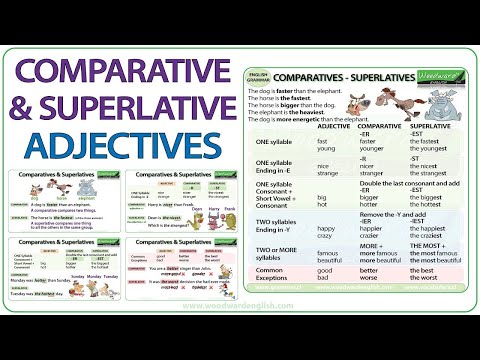
The formation of the comparative and superlative depends on the number of syllables in the adjective:
One-syllable Adjectives
To form the comparative, we add -er to the end of the adjective.
To form the superlative, we add -est to the end of the adjective.
| Adjective | Comparative | Superlative |
|---|---|---|
| small | smaller | the smallest |
| cold | colder | the coldest |
| light | lighter | the lightest |
| wide * | wider | the widest |
| hot ** | hotter | the hottest |
* When an adjective ends in the letter E, we just add the -R (for comparatives) or -ST (for superlatives). We do not write two Es together. Wider (correct) not wideer (incorrect).
** When an adjective ends in a consonant + short vowel + consonant (C + V + C), we normally double the last letter. big – bigger – biggest, wet – wetter – wettest
- London is bigger than Santiago.
- Mike is taller than John but James is the tallest.
- Yesterday was the hottest day of the year.
- It is the oldest building in the village.
- I want a faster car.
Notice how comparatives are often followed by than when comparing two things or people.
Two-syllable Adjectives ending in -Y
To form the comparative, we remove the -y and add –ier to the end of the adjective.
To form the superlative, we remove the -y and add –iest to the end of the adjective.
| Adjective | Comparative | Superlative |
|---|---|---|
| crazy | crazier | the craziest |
| happy | happier | the happiest |
| early | earlier | the earliest |
- It was the happiest day of my life.
- My joke was funnier than your one.
- This section is easier than the rest.
Adjectives with Two or more Syllables
For Adjectives with 2 syllables (that don’t end in -y) and higher (3, 4 syllables etc), we use more for comparatives and the most for superlatives.
| Adjective | Comparative | Superlative |
|---|---|---|
| handsome | more handsome | the most handsome |
| nervous | more nervous | the most nervous |
| enthusiastic | more enthusiastic | the most enthusiastic |
- My girlfriend is more beautiful than yours.
- Alex is more intelligent than you but I am the most intelligent.
- It was the most wonderful day I have ever had.
Some exceptions with two-syllable adjectives ending in -er and -est:
narrow – narrower, simple – simpler, quiet – quieter
Irregular Forms
| Adjective | Comparative | Superlative |
|---|---|---|
| good | better | the best |
| bad | worse | the worst |
| far *** | further / farther | the furthest / farthest |
| little | less | the least |
| many/much | more | the most |
| old **** | older/elder | the oldest / eldest |
- I am a better tennis player than you but Marcelo is the best.
- Steve is a worse liar than me but Adrian is the worst.
*** Farther – Further
Further / farther, furthest / farthest are all used for distance.
Only Further / furthest are used to mean ‘additional’ or ‘more advanced’.
- Puerto Montt is further / farther than Valdivia is from here (in Santiago).
- If you require further information, please contact reception.
Remember that the opposites of ‘more’ and ‘most’ are ‘less‘ and ‘least‘, respectively.
**** Older – Eldest
We use elder / eldest when we are talking about family relationships and normally only before a noun (not by itself unless it is a pronoun).
- He is my elder brother. (We cannot say: My brother is elder than me. – incorrect)
- The eldest sister would pass on her dresses to the younger one.
Comparative and Superlative of ILL
When comparing how ill people are, you will normally hear worse or the worst and not “iller or illest“. Some people may prefer to replace ill with sick (sicker, sickest) when comparing.

