


Let’s Learn “Telling Time”
There are two common ways of telling the time.
1) Say the hour first and then the minutes. (Hour + Minutes)
- 6:25 – It’s six twenty-five
- 8:05 – It’s eight O-five (the O is said like the letter O)
- 9:11 – It’s nine eleven
- 2:34 – It’s two thirty-four
2) Say the minutes first and then the hour. (Minutes + PAST / TO + Hour)
For minutes 1-30 we use PAST after the minutes.
For minutes 31-59 we use TO after the minutes.
- 2:35 – It’s twenty-five to three
- 11:20 – It’s twenty past eleven
- 4:18 – It’s eighteen past four
- 8:51 – It’s nine to nine
- 2:59 – It’s one to three
When it is 15 minutes past the hour we normally say: (a) quarter past
- 7:15 – It’s (a) quarter past seven
When it is 15 minutes before the hour we normally say: a quarter to
- 12:45 – It’s (a) quarter to one
When it is 30 minutes past the hour we normally say: half past
- 3:30 – It’s half past three (but we can also say three-thirty)
O’clock
We use o’clock when there are NO minutes.
- 10:00 – It’s ten o’clock
- 5:00 – It’s five o’clock
- 1:00 – It’s one o’clock
Sometimes it is written as 9 o’clock (the number + o’clock)
12:00
For 12:00 there are four expressions in English.
- twelve o’clock
- midday = noon
- midnight
Asking for the Time
The common question forms we use to ask for the time right now are:
- What time is it?
- What is the time?
A more polite way to ask for the time, especially from a stranger is:
- Could you tell me the time please?
The common question forms we use to ask at what time a specific event will happen are:
What time…?
When…?
- What time does the flight to New York leave?
- When does the bus arrive from London?
- When does the concert begin?
Giving the Time
We use It is or It’s to respond to the questions that ask for the time right now.
- It is half past five (5:30).
- It’s ten to twelve (11:50)
We use the structure AT + time when giving the time of a specific event.
- The bus arrives at midday (12:00).
- The flight leaves at a quarter to two (1:45).
- The concert begins at ten o’clock. (10:00)
We can also use subject pronouns in these responses.
- It arrives at midday (12:00).
- It leaves at a quarter to two (1:45).
- It begins at ten o’clock. (10:00)
AM vs. PM
We don’t normally use the 24-hour clock in English.
We use a.m. (am) for the morning and p.m. (pm) for the afternoon and night.
3am = Three o’clock in the morning.
3pm = Three o’clock in the afternoon.

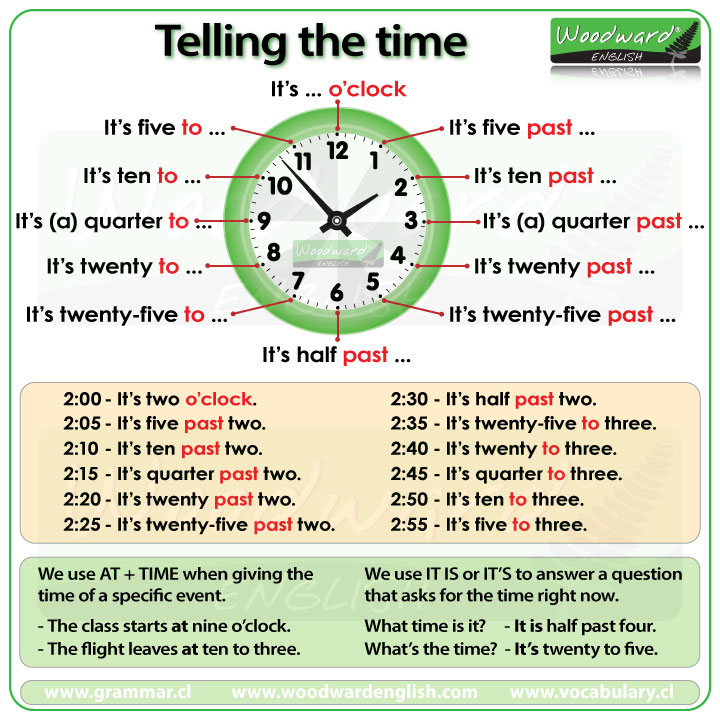
Source: Woodward English
Online Clock to Practice
Online Clock to Practice by TopMarks
Online Clock to Practice by MoonBow